Project narrative
The project is underpinned by scientific fact. Its scenarios emerge from evolving debates in the scientific community about future rising sea levels, changes in land mass, species hybridity, advancements in genetic modification, among others. This is accompanied by research of archive and documentary footage, which is woven into the films’ narrative structure to create a distinctive blend of real footage and fictional storytelling steeped in scientific fact.
The project involves site research in places where the different film episodes are set and where the multiple project iterations are presented, as well as long-term collaboration and ongoing dialogue with scientists (including marine biologists, oceanographers, trauma specialists), anthropologists, architects, philosophers, musicians, activists and other artists. This deeply situated research and dialogue directly inform the direction of the evolving narrative of Leviathan Cycle and the resulting site-responsive presentations of the project. No less significant than the other parts of the project, the conversations with collaborators are integrated into Leviathan’s dynamic public programme and can be accessed through its online platform.
For the Leviathan VR trilogy I worked closely with scientists currently future-casting what our oceans will look like 150, 300 and 500 years into the future to visually render oceanic landscapes and species. A by-product of this collaboration is a set of research papers, specially commissioned for the Leviathan online platform, on topics ranging from human rights to the life of microbes, artificial islands, biopunk and more.
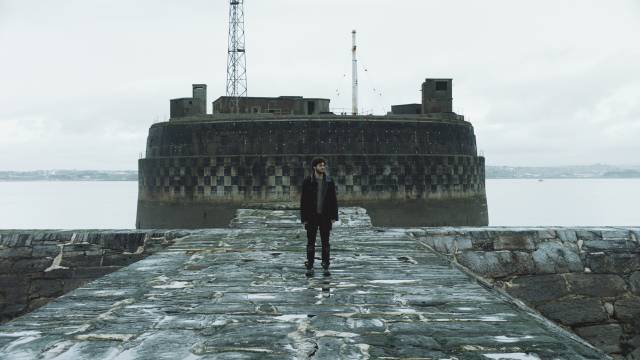
Following the inaugural presentation of episodes 1– 3 in Venice (at Palazzina Canonica in collaboration with Fondazione Querini Stampalia) in May 2017 to coincide with the 57th Art Biennale. To date, eight of the ten films in the Leviathan Cycle films have been produced. Alongside two (of a planned three) virtual reality works: Leviathan Legacy: Part 1 (2018, premiered at West Bund Art & Design, Shanghai) and The Terrarium (2020, premiered at Kai Art Center, Tallinn). Episodes 1– 3 of the films introduce the protagonists Ben and Yasmine, who are travelling south from Britain and stop off at an island on the Venetian lagoon. The following notes on the different episodes highlight the diverse subject matter Leviathan draws upon and references.
Leviathan Cycle, Episodes 1– 3 (2017)
(Single screen, duration variable, commissioners include University of Salford Art Collection, Outset Contemporary Art Fund, Leviathan – Human and Marine Ecology and CREAM)
These episodes provide the backstory to the narrative: a solar cataclysm that has wiped out a large part of the human population. Ben reminisces about his childhood spent roaming the back corridors of London’s Natural History Museum. Yasmine, a woman of North African origin, ekes out an existence in the derelict, former Victorian market hall in Plymouth. A young man arrives, and we follow Yasmine’s inner monologue and exterior journey, through musings on borders, migration, species and social niceties. Ben and Yasmine encounter a bacchanalian community on a Venetian island.
Leviathan Cycle, Episode 4 (2018)
(Single screen, 10:36; commissioned by Arts Council England; Barakat, Seoul; HE.RO Amsterdam; and Leviathan – Human & Marine Ecology)
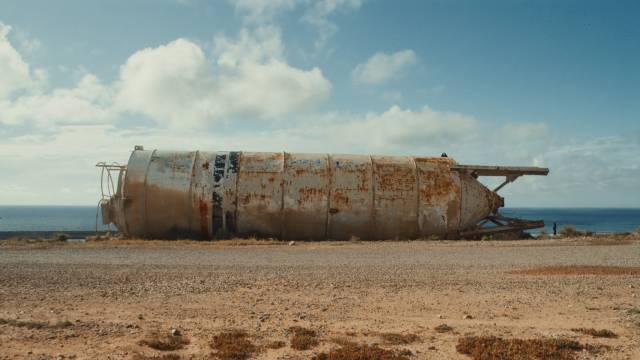
Ben and Yasmine continue to the Moroccan coast, where they come under attack from bandits. The ethics of survival and predator-prey relationships in both human and marine species are explored. Filmed on location in Sidi Ifni, Morocco, the episode emerged out of my research on coastal geographies in southern Morocco and their relationship to pre-Islamic mythical structures. I have been visiting Sidi Ifni since 2002, and the location was the site of my 2014 work Towards the Possible Film.
I was interested in interfacing the site and historical specificity of Sidi Ifni with ideas of geology from a climatic point of view, which by extension allowed for thinking of predator-prey relations in marine zones on the Atlantic coast of Morocco. As with all Leviathan films, the footage is interspersed with archive and documentary footage. I worked closely with Getty Images, the University of Plymouth Marine Institute and prize-winning marine biologist and videographer Mae Dorricott on this episode. The film is narrated in Moroccan Arabic, underscoring the site-responsive approach of my film-making.
Leviathan Cycle, Episode 5 (2018)
(Single screen 19:28, commissioned by A Tale of a Tub, Rotterdam, and a Canadian partnership between Fogo Island Arts, Newfoundland and Toronto Biennial of Art)
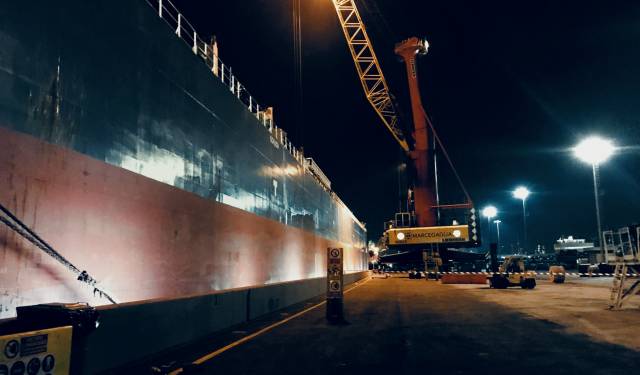
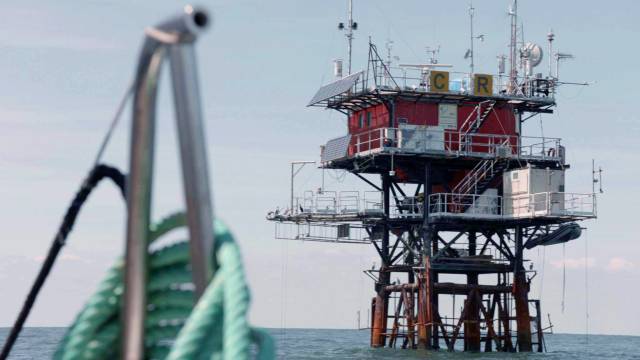
The episode takes its cue from globalisation, international trade and the legal structures of maritime law set against the rights of the individual. Ben and Yasmine are taken captive aboard a gigantic cargo ship, whose megalomaniacal captain Ismael entertains biblical pretensions. Ben is made to “pay his passage”, while a ghostly Yasmine stalks the the ship. Whales and whaling become a key subject – interrogating colonial and indigenous politics in the process. In this episode, I questioned what the idea of international waters might come to mean with rising sea levels, moving backwards and forwards in time through archives to examine history with a Canadian connection.
Leviathan Cycle, Episode 6 (2020)
(Single screen, 18:46, commissioned by CCA, Tel Aviv; Outset Contemporary Art Fund; The (He)art for (He)art Program; and Arts Council England)
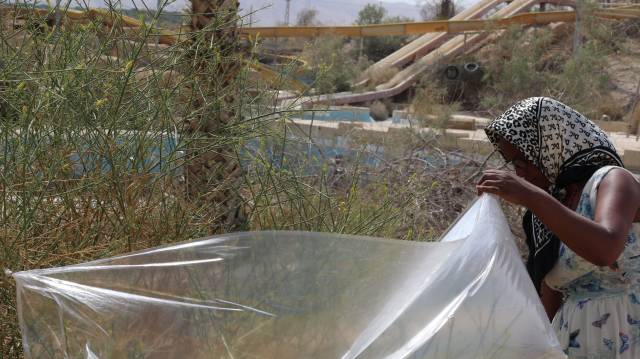
This episode marks a shift in the methodology of Leviathan, moving from a single to dual narrators to voices of African refugees passing through Sinai and to ask questions about borders. I travelled to the Dead Sea to film on-site, but as a result of covid-related travel restrictions had to adapt the second leg of filming. In researching and writing the episode, I collaborated with various trauma specialists, from psychiatrists to legal activists who deal with African refugees and those affected by the Israeli-Palestinian conflict. The delicate and complex theme of the episode involved working with people of Ethiopian and Eritrean heritage, using the climatic context of the Dead Sea and its evaporation as a metaphor for the invisibility and/or erasure of certain peoples. A motif of Leviathan is the attempt to find empathy, but it also asks whether it’s possible to speak for someone else.
Leviathan Cycle, Episode 7 (2022)
(Single screen, 14'42'', commissioned by Toronto Biennial of Art and Leviathan - Human & Marine Ecology. Courtesy of the artist and UBIK Productions)
This episode is intertidal, locating itself in and as mangrove by speaking to interconnectedness and enmeshment. Situated in the second half of Leviathan Cycle, this episode moves beyond an exploration of environmental, physical, and psychological breakdown to instead consider new strategies for working and living together.
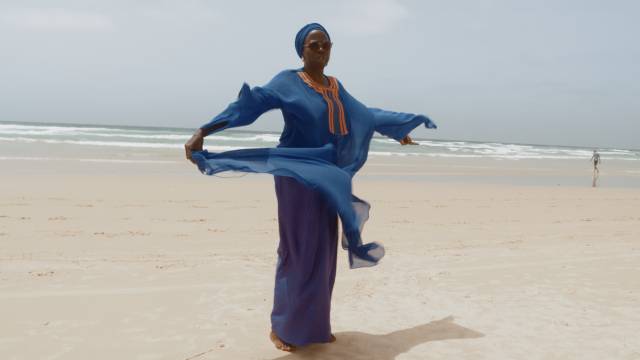
The film’s fluid journey through Senegalese landscapes moves in tandem with accounts by participants – the writer Ken Bugul and the lawyer and community organiser Africana, both actively concerned with de-colonial practices – who have been invited to image and imagine themselves as their future selves. This discursive, collaborative exercise in place-making is one where both science and the imaginary dovetail into a possible, collective futurology. In blending fact and speculative fiction, narrative and documentary, Shezad enacts a unique, sliding temporal scale that underlies the entire Leviathan project, connecting deep time to tentative futurity.
Leviathan Cycle, Episode 8 (2023)
(Single screen, 17'33'', commissioned by Hybrid Futures (a multi-part collaboration focusing on climate, sustainability, collaborative learning and co-production between Castlefield Gallery, Manchester; Grundy Art Gallery, Blackpool; Touchstones Rochdale; University of Salford Art Collection and Shezad Dawood Studio, and generously supported by Arts Council England and Art Fund), Leviathan — Human & Marine Ecology and The Void, Derry. Courtesy of the artist and UBIK Productions.)
This episode considers some of the urgent issues of our time such as climate change. Episode 8 was developed remotely in collaboration with Guarani scriptwriters, directors and activists Carlos Papá, Cristine Takuá, Sandra Benites, and Brazilian artist and researcher Anita Ekman. This film not only expands the collective and horizontal filmmaking method that has become a central feature of the cycle's second half, but reduces its own environmental impact through an intimate yet remote co-authorship.
Set in the Brazilian Atlantic Forest – one of the most ecologically diverse and threatened biomes on earth – Episode 8 blends indigenous cosmology with fictional narrative, shot footage and especially commissioned animation by Anita Ekman, to chart an embodied, spiritual and ecological journey along the age-old Guarani path that links the forest to the sea.
Virtual reality: Leviathan Legacy: Part 1 and Part 2, The Terrarium
Building on the Leviathan film series, the VR trilogy jumps 150, 300 and 500 years into the future, respectively. Without a James Cameron budget, the immersive medium of VR was perfect for presenting speculative futures. Akin to world-building science fiction, this project uses cutting-edge research to imagine and put the viewer in the middle of a plausible, yet playful narrative journey through our coastal and marine environment of the future. Informed through dialogue with marine scientists – most notably, Madeleine van Oppen, an ecological geneticist with an interest in the climate change adaptation of reef corals, and Louise Firth, a marine ecologist at the University of Plymouth – oceanographers and futurists, each instalment imagines the speculative future of reef ecosystems, interspecies hybridity and aquatic moons.
Leviathan Legacy: Part 1 (2018)
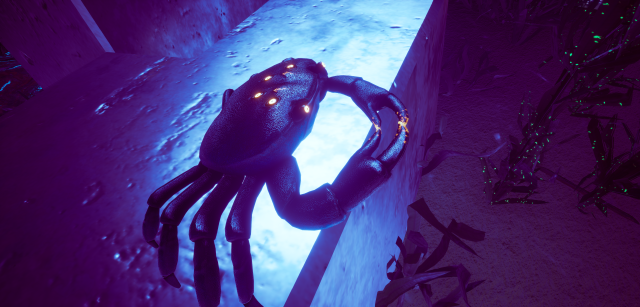
Developed in partnership with marine scientists at the University of Plymouth, Leviathan Legacy: Part 1 is set 150 years in the future on a beach in Cuba, where rising sea levels and calcification of the oceans have led to new hybrid species and social hierarchies. Led by a talking crayfish, the viewer is invited to explore underwater landscapes altered by climate change.
Leviathan Legacy: Part 2, The Terrarium (2020)
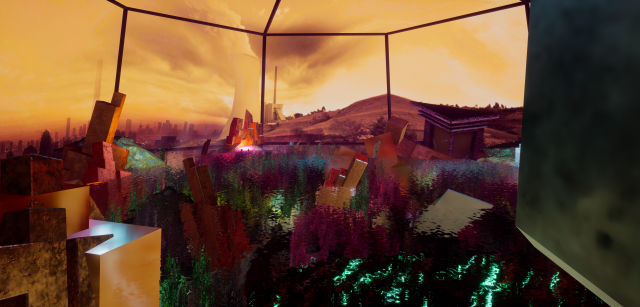
This is the latest virtual reality experience to grow from the Leviathan body of work, and it takes the viewer 300 years into the future, when 90% of the planet’s surface has become covered by water. As a hybrid human-cephalopod, you are released from a laboratory to survey an unbroken stretch of water connecting Kent to the Baltic, where you will meet organisms that have evolved through genetic mutations due to a changed climate. This VR was developed in partnership with Estonian marine biologists, historians and anthropologists.
| Creators | Dawood, S. |
|---|---|
| Description | Emerging from Dawood’s research-led film-making methodology, this interdisciplinary project involves collaboration and dialogue with scientists, anthropologists, philosophers, lawyers, activists, futurists, and trauma specialists. At all Following its inaugural presentation in Venice in May 2017 to coincide with the 57th Art Biennale, Dawood’s Leviathan has facilitated and produced over 30 talks and events alongside exhibitions aimed at encouraging cross-disciplinary dialogue. Distinguished speakers have for example included the theorist Franco ‘Bifo’ Berardi in conversation with leading oceanographer Sandro Carniel; Cristina Cattaneo director of the LABANOF at the University of Milan, whose work operates at the frontline of the refugee crisis; and pioneering evolutionary geneticist Eske Willerslev. To date, eight of the ten films in the Leviathan Cycle have been produced. These works have been presented at film festivals including CPH:DOX (Copenhagen, Denmark), Oberhausen (Oberhausen, Germany), and Kino der Kunst (Munich, Germany), Skabmagovat Festival (Inar, Finland) and at one-off screenings and special events with partners including Elephant Magazine and the Goethe-Institute. |
| Portfolio items | Leviathan |
| Leviathan | |
| Year | 2017 |
| Publisher | University of Westminster |